The Traditionalists
Damiani studied the works by “Traditionalist” or “Perennialist” authors such as René Guénon, Frithjof Schuon, Titus Burckhardt, and Julius Evola. Although he sometimes criticized them for writing in an arrogant and pretentious manner, he often used Guénon’s fivefold hierarchy of principles: (1) the Infinite, or Beyond Being, (2) Being, the principle of manifestation, (3) the causal or formless level of manifestation, (4) the subtle, and (5) the gross levels of formal manifestation.
Text items highlighted in yellow below are links into the archive for the topics, keywords, and search methods being discussed. Use them as a starting point to explore the archive, and as a shortcut to doing the searches.
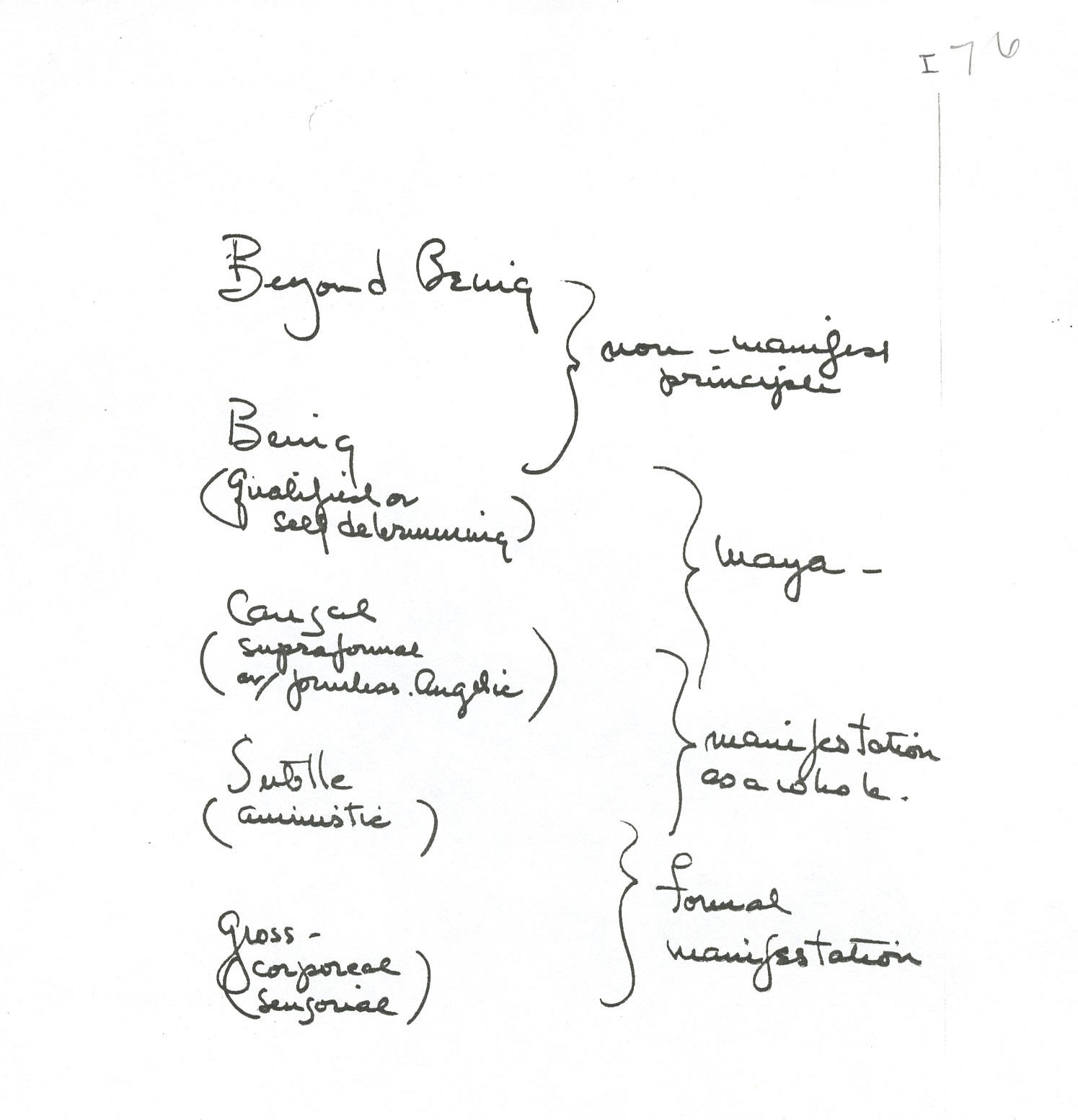
Diagram of Guénon’s five levels. Photo of Anthony Damiani’s drawing on a blackboard, probably at the American Brahman Bookstore, Ithaca, NY.
He also thought highly of Guénon’s The Multiple States of Being, especially his exposition of the concept of the Infinite as excluding all limitations, which means it is absolute affirmation, and of the related notions of Universal Possibility and Active and Passive Perfection.
He found another of Guenon’s books, Man and His Becoming according to the Vedānta, useful for its discussion of the self’s vehicles in terms of the tattvas of the Samkhya system of Indian thought and its discussion of the three conditioned states of the self (Atmā)—deep sleep, dream, and waking—and the unconditioned state of Atmā, the fourth (turiya). As he developed more precise language to describe the individual soul and its journey through the cosmos, making use of both Plotinus’s and PB’s insights, he criticized Guenon for not making clear all that is involved in the soul’s association with its vehicles, especially the role of the cosmic soul and its wisdom in providentially arranging experiences to educate the individual soul.
Most of the classes on the Traditionalists are either ones for which we have no audio, just scans of class summaries that have not yet been turned into Word documents, or ones for which the audio has not yet been transcribed.