The Astrological Mandala and Astrology’s Transcendental Ground
Damiani was a self-taught philosopher and metaphysician. He didn’t have any allegiance to particular thinkers or spiritual traditions. Rather he believed that the Truth was so complex and all-encompassing that any approach to it apart from directly entering thought-free contemplation required seeing it from as many perspectives as possible and seeing how these perspectives were related in various ways. Thus he also sought a symbol that would enable and encourage a synthetic approach to philosophical problems. He found this symbol to be on the one hand, the universe itself, especially as represented in the Ptolemaic perspective, which privileges a human, Earth-centered view of the universe, and on the other, the astrological mandala, in which a circle is divided into twelve equal sectors (houses), each ruled by one of the twelve signs of the zodiac and containing just those planets that are in dignity in that house. Each house represents a Divine Idea (substance) and the planets in that house represent the functions that manifest the Idea. On the outside of the circle are keywords indicating the meaning of each house in terms of its Divine Idea.
Text items highlighted in yellow below are links into the archive for the topics, keywords, and search methods being discussed. Use them as a starting point to explore the archive, and as a shortcut to doing the searches.
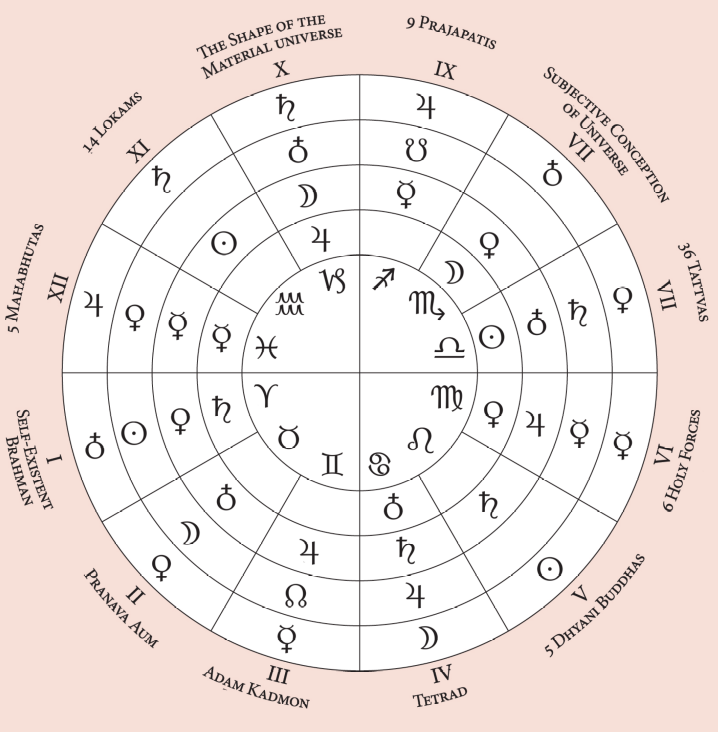
The metaphysical chart. (Reproduced courtesy of Wisdom’s Goldenrod. From Anthony Damiani, Astronoesis: Philosophy’s Empirical Context, Astrology’s Transcendental Ground, fig. 12, p. 53.)
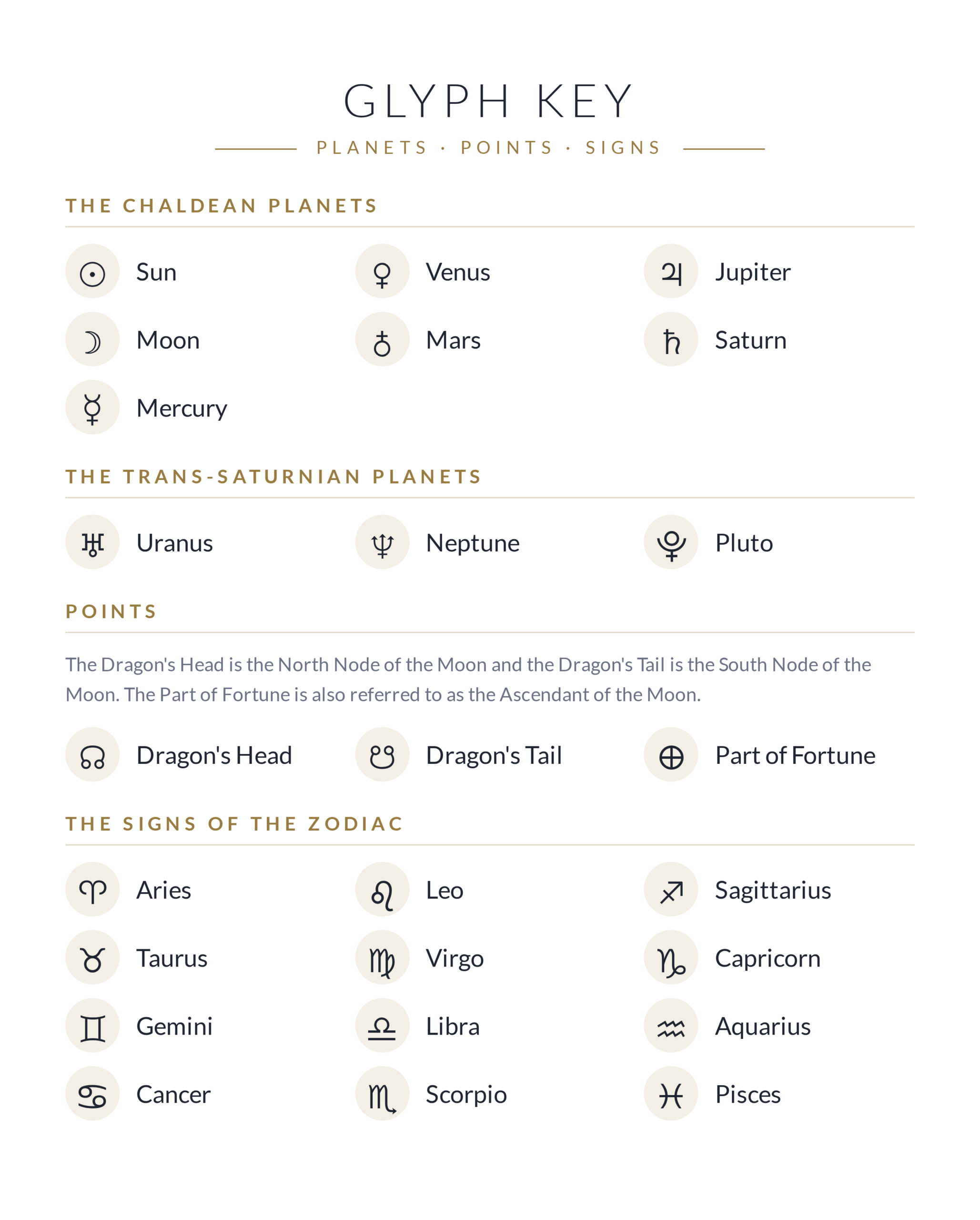
If you are not familiar with the glyphs for the planets and zodiacal signs, here is a useful key.
For a more detailed description of the components of the astrological mandala, also called the “metaphysical chart” in various class transcripts, and the concept of the four essential dignities in astrology, see About the metaphysical chart
Discovering the Astrological Mandala
The story of how Damiani discovered the astrological mandala is itself interesting. In 1982, he remarked during a class that he first became preoccupied with the “idea of astrology, all the implications in astrology” when there was a Uranus-Pluto conjunction transiting conjunct his natal Mercury at 17 degrees Virgo. This was in 1964–65. And interestingly, the Isidore Kozminsky symbol for 17 degrees Virgo is “an astrologer seated at a desk, his head resting on his left hand, judging a nativity”! When he opened the American Brahman Bookstore in Ithaca, NY, a few years later (the summer of 1967), he encouraged two of the initial visitors, Lenny Silver, a professor of mathematics at Cornell University, and Timothy Smith, an undergraduate at Cornell, to learn to cast horoscopes and learn about astrology. The bookstore had some books about astrology, including the complete lecture notes of Marc Edmund Jones and a few books by Alan Leo, which they devoured. Eventually, they began offering classes on astrology at the bookstore, which attracted many more people, both from Cornell and the surrounding city.
Meanwhile Damiani continued his own study of astrology. After he began teaching classes drawing on the writings of PB, Carl Jung, Buddhism, Samkhya, Advaita Vedanta, and Theosophy in the evenings at the bookstore, he would sometimes put up the chart of a student on the blackboard and discuss the way the chart represented the structure of their ego. Moreover the transits of planets to the natal chart showed how this structure was being transformed by life experience—for example, it was being educated, developed, refined, or purified. He increasingly found that understanding astrology provided valuable insights into people’s character, and more importantly, into the soul’s purpose in living this human life.
But he was still in search of a deeper meaning to the astrological horoscope. It wasn’t until the summer of 1972 that he had a “eureka moment” that revealed the truly metaphysical significance of the twelve signs of the zodiac. This powerful intuition-vision was provoked by his reading of an article by T. Subba Row, a theosophist, titled “The Twelve Signs of the Zodiac.” T. S. Row used certain hermeneutical and numerological techniques practiced by Sanskrit scholars to unfold the meanings of the Sanskrit names for the twelve signs of the zodiac. The result was a revelation of a metaphysical structure stretching from the Self-Existent Brahman (Aries) to the five elements that constitute the appearance of the universe (Pisces). This was the key Damiani had been looking for. Now he was able to map on to the twelve signs of the zodiac corresponding principles from other traditions: Plotinus, Advaita Vedanta, Samkhya, Kashmir Shaivism, Proclus, Tibetan Buddhism, Jung.
When the Hellenistic astrological schema in which certain planets are said to be in dignity when residing in certain zodiacal signs (rulerships, exaltations, detriments, and falls) is combined with T. S. Row’s meanings for the signs, a comprehensive symbol emerges—the astrological mandala.
Damiani didn’t regard the astrological mandala as merely a product of conceptual speculation. Rather, in a paper, coauthored with Tim Smith and Avery Solomon, they wrote:
It is our belief the astrological mandala is a fragment of an archaic wisdom, and was devised by the profoundly wise sages of the past. This mandala of the signs and planets is a rare instance of—and product of—the archetypal imagination; it presents the topography of the subtle world through the forms available in sensible becoming. This root symbol of astrology represents a formulation by reason principles of a symbolic method through which those very reason principles are being manifested. Reason principles are those living meanings or categories of thought that are the substantial aspect (forms) of the soul. (Undated paper, “Reading a Chart”)
Working out the meanings hidden in the astrological mandala then became his preoccupation, and he was developing a book-length ms. about his insights when he died in 1984. The ms. was completed by some of his students and published posthumously in 2000 as Astronoesis: Philosophy’s Empirical Context, Astrology’s Transcendental Ground. You can learn more about Astronoesis in the section titled “Plotinus and Astronoesis.”
Reading the Natal Charts of Accomplished Individuals
Alongside the classes devoted to unfolding his vision of the metaphysical chart were classes concerned with the art of reading a natal chart and the epistemology of astrology. Having placed astrology on a proper metaphysical foundation, he was interested in how its principles could be applied to understanding all the factors involved in reading a chart. There were both classes on the theory of astrology and intensive seminars that focused on reading the natal charts of well-known individuals such as Napoleon, Mahatma Ghandi, Ralph Waldo Emerson, Eleanor Roosevelt, Carl Jung, J. Robert Oppenheimer, Giacomo Puccini, Rimsky-Korsakov, and many more.
You can find transcripts of many of the classes on the horoscopes of these individuals on the class series page or by searching under their last name in the document archive. The titles in the series all have the form “Astrology: [X’s] Horoscope,” where “X” stands for the person’s last name.
There were often several classes devoted to a single individual. First a biographical sketch would be assembled of the major events in their lives, and then the class would look at their natal chart, including the degree symbols for the natal planets, the natal aspects, and then transits and progressions. An effort would be made to correlate transits and progressions with the events listed in the biography. The aim was to get the broadest picture of the individual, from birth till death, in order to understand the patterns in the soul at the moment of birth and what the soul was trying to achieve in that particular life. These classes forged and refined the application of astrological principles to reading a natal chart. The understanding of these principles evolved and developed over time, and sometimes prior meanings were superseded by later ones.
Astrological Theory
The classes on the theory and epistemology of astrology covered many topics—too many to discuss in detail in this overview. But it might be useful to mention some of them here since they can serve as sources of keywords for searching the archive:
- the difference between the sidereal and tropical zodiacs
- the tropical zodiacal degrees as units of meaning and how they are symbolized by the various degree symbol dictionaries
- the natal planets as categories of the imagination vs. transiting planets as powers of the rational soul
- the nature of the trans-Saturnian planets of Uranus, Neptune, and Pluto
- how transits by the trans-Saturnians differ from transits by the Chaldean planets
- the three types of aspects (regular—that is, conjunction, semisextile, sextile, square, trine, quincunx, opposition—quintiles and septiles)
- the three levels of subjectivity symbolized by the chart (bodily, psychical, and spiritual)
- the meaning of the Arabic parts
There is a class series on Arabic parts, see “Astrology Theory: Arabic Parts.”
To find transcripts and papers on astrology theory, search the document archive using “theory” as a keyword. Most, but not all, of these will be on astrology theory.