DISCOVERING

Paul Brunton as Spiritual Guide

In the 1940s, Anthony Damiani was working in Weiser’s, a popular New York City bookstore that featured books on spirituality and the occult. It was there that he discovered books by Paul Brunton, a prolific English writer who traveled in India in the 1930s to discover people who possessed genuine spiritual gifts. His first book, A Search in Secret India, quickly became a worldwide success and an awakener of readers to the profundity of Indian spirituality. 

A Search, first published in London in 1934, skyrocketed to popularity and has since sold over 500,000 copies worldwide. Along with Autobiography of a Yogi and Christopher Isherwood’s Ramakrishna and His Disciples, it continues to be one of the most inviting, exciting gateways to the mystical Hindu environment.” –Hinduism Today, Dec., 1991

PB, as he liked to be called, rapidly became the go-to authority on Eastern Spirituality in the course of authoring another ten well-received books by 1942. He re-visioned, in English for the modern era, the Perennial Spiritual Philosophy. Especially significant for aspiring mystics and philosophers were his books The Quest of the Overself, The Hidden Teaching Beyond Yoga, and The Wisdom of the Overself. These titles were likely the ones that propelled Damiani to ask Dutton, the publisher, to forward a letter to PB requesting an interview. As it turned out, PB was staying in NYC at the time; they met, and Damiani offered to be of assistance to PB. (For in-depth information about PB’s life and writings, see the website of the Paul Brunton Philosophic Foundation, www.paulbrunton.org.)

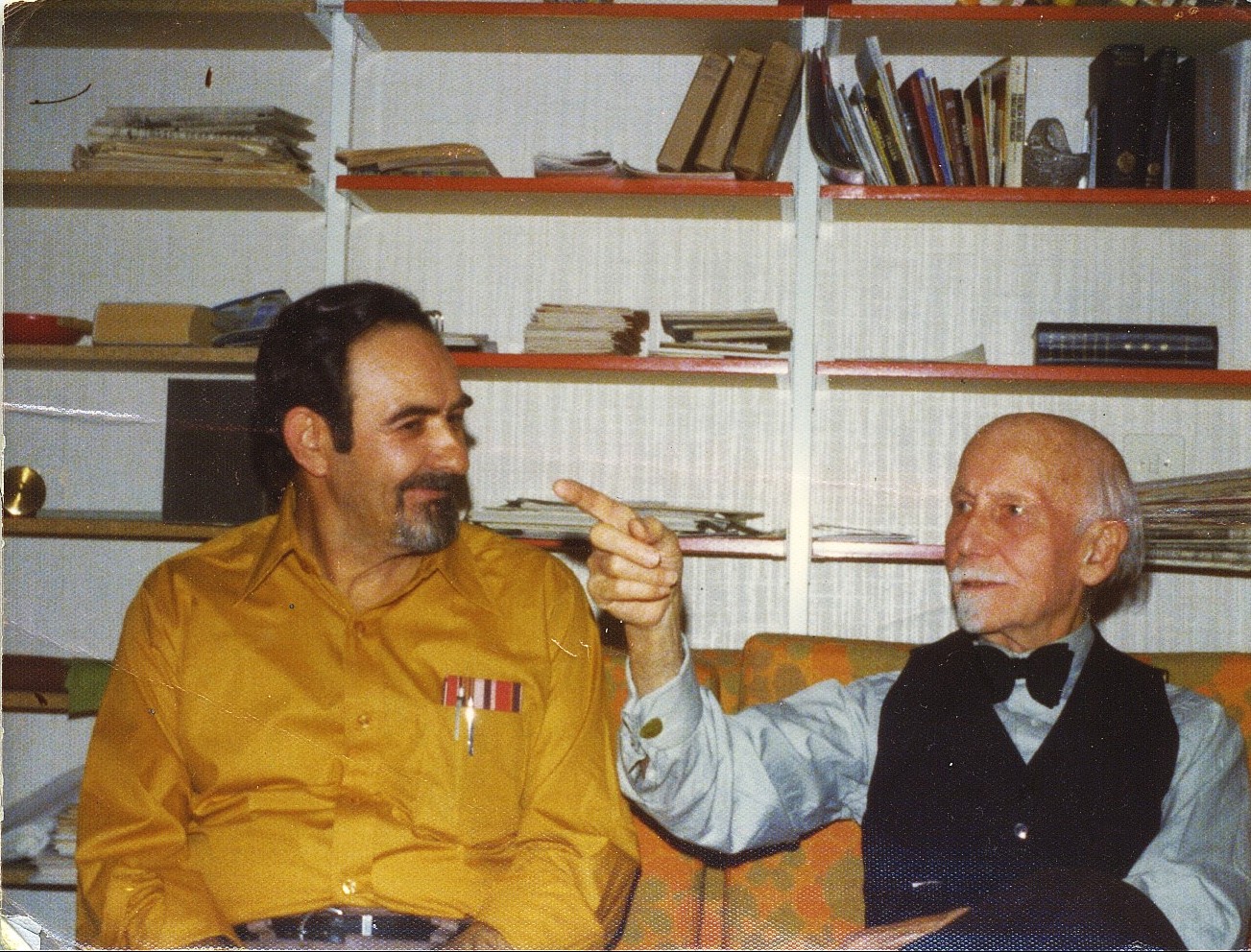
Fast-forward to 1967, when Damiani’s son Steve Damiani opened the American-Brahman Bookstore in Ithaca, NY. The following year, Anthony Damiani began giving classes to a quickly growing number of students. They focused on the writings of Paul Brunton, Carl Jung, Plotinus, as well as Vedanta, Buddhism, and Astrology. Damiani was broad in his approach, following up ideas or themes in the literature of various philosophic traditions to deepen his understanding of those themes. And Paul Brunton was a continual and major source for Damiani’s explorations and class discussions.
1

Early in his teaching career, Damiani devoted a significant amount of class time to understanding one of PB’s major themes, a nondual epistemology that PB termed mentalism. Understanding this subject is key to comprehending the major themes of spiritual philosophy: What is Self? What is God? and What is the

In The Hidden Teaching Beyond Yoga, PB unfolds in a rational step-by-step manner, following the science of how sensible knowledge arises, an explanation of how the assumptions of science result in an unsupportable assertion that somehow material impulses become consciously known. In Looking into Mind, a presentation of Damiani’s teachings on mentalism and meditation that he offered to a PB group in Sweden, we read this challenging and thought-provoking statement by PB:

“All things are mental things; this alone do we know indubitably. Yet nobody will repudiate realism and accept such doctrine with confidence until he has previously prepared himself for it by inquiry and reflection, and unless he has been led to it by the sheer rational force of what he has thus ascertained. For the innermost beliefs of the masses will always be outraged by such a fact because their primary instinct is impulsively and prematurely to take things as they appear to be, whereas the philosopher can only arrive at his truth as the final step in a long journey.”

“That the percept is an idea, we know; that a material thing is the basis of this idea is mere conjecture. That there is a material object apart from and outside of the perceived mental image of it or corresponding to the idea formed of it, is only an inference. Its independent existence cannot be proved and cannot be established.”

2

The Wisdom of the Overself presents PB’s grand vision and explanation of the multi-faceted and multi-layered spiritual nature of the universe and of the individual experiencing it. Damiani devoted many classes to this text, especially the chapters: “The Birth of the Universe” and “The Secret of the I.”
3

By acknowledging the importance of the development of a mature individuality, PB and Damiani felt strongly about following an independent path, i.e., that each person is a unique expression of the World-Idea, and as such the unfoldment/individuation and experiential needs of each will be different. In Damiani’s class transcripts on PB’s teachings on egoity (that became the book Standing in Your Own Way), he explains that it is ego-tyranny that will be out-grown on the spiritual path so that the person can then serve and express the deeper wisdom. From that book:

Damiani: “No, the ego cannot find truth because obviously the way it will get the truth is when it gives itself up. Now when it gives itself up, there’s no ego that wins the truth. You want the truth? You get rid of your ego. But at the same time, you’re not going to get rid of your ego until you have sufficiently developed it, purified it, and brought it under the higher discipline, the higher philosophy.”

Student: “It’s in that sense that you mean ‘get rid’ of it?”

Damiani: “Actually, you don’t get rid of it, you have to transform it. Remember, PB makes the point over and over again that the ego has to be evolved, matured. It won’t be capable of that sacrifice until it does reach that maturity.”

4

Another major theme in Paul Brunton’s writing is the developmental stages of the spiritual quest that culminate in becoming a fully developed human, a realized sage or what PB chose to term a “philosopher.” Damiani considered PB to be a sage and encouraged his students to meet with him.

PB writes: “In the first stage of progress we learn to stand aside from the world and to still our thoughts about it. This is the mystical stage. Next, we recognize the world as being but a series of ideas within the mind; this is the mentalist-metaphysical stage. Finally, we return to the world’s activity without reacting mentally to its suggestions, working disinterestedly, and knowing always that all is One. This is the philosophical stage.”

Damiani taught many classes focused on studying in-depth PB’s writings on this goal of spiritual development in all of its implications and ramifications, and these transcripts have been edited into Living Wisdom: Revisioning the Philosophic Quest.

Here is a taste of this book.

Damiani: “Now, what he’s saying here is very important. The sage finds that the world without—the externally manifested idea of the world—is one’s own inner self. That’s quite advanced. There are mystics who have an experience, a glimpse, of their own higher self, and they become recluses and hermits; they run away. But there’s another kind of experience that some mystics have where they feel the sacredness of everything around them. They become acquainted with the fact that the World-Idea being manifested in them is also of the nature of the ‘I.’ It can actually occur that you come out of a trance state like that and bump into a chair and say, ‘Excuse me’; you actually feel the sacredness of the whole world. This is not common for most mystics. At any rate, PB is pointing out here that these are shortcomings that mystics have. First of all, it’s not a continuous light; it flickers; even worse, it goes off and goes on again.”

PB quote: “On the other hand, the sage finds reality in the world without, as his own self, at all times and not at special occasions, and wholly rather than in glimpses. The mystic’s light comes in glimpses . . . a flickering unsteady and uneven flame, whereas the sage’s is like a lamp that never goes out.”

Damiani: “The insight of the philosopher continuously sees that consciousness underlies the reality of objects. It’s always there for the philosopher-sage.”

After PB stopped authoring books (the last appeared in 1952), he continued to write for the next thirty years and created a large body of work that became twenty-eight topical categories on every aspect of spiritual development (a major selection is contained in the posthumous The Notebooks of Paul Brunton). And a complete digital archive of his work can be found at the Archives of Paul Brunton, https://www.pbarchives.org/. It is a testament to Damiani and his students who worked tirelessly for many years to comprehend the major topics of the Perennial Philosophy that at the end of PB’s life, he trained Damiani’s students to act as editors for his large written legacy to be processed for publication and preservation. This was a multi-stepped and multi-year endeavor by many of Damiani’s students.

Damiani spent hours poring over the unpublished writings and devoted many classes (in 1982-84—the final years of his life) to the topics already mentioned and also to PB’s teachings on Mind-in-Itself, World-Mind, World-Idea, Overself, the sage, the intellect, meditation, emotions and ethics. The transcripts of these classes are preserved in this archive.