Advaita Vedanta
The Advaita Vedanta is the nondual school of the Vedanta tradition of Indian philosophy. Given the large number of books on Advaita Vedanta in the Wisdom’s Goldenrod library, which were donated by Anthony Damiani from his personal collection, he spent many hours studying these texts. Also, as mentioned above, his spiritual guide was Paul Brunton, who was instrumental in presenting Asiatic wisdom to the West as a living spiritual tradition. PB, as Paul Brunton preferred to be called, in turn had several teachers in the Advaita tradition, including Ramana Maharshi, the Jagadguru Shri Chandrasekharendra Saraswati Shankaracharya Mahaswamigal, and Sri V. Subrahmanya Iyer.
Text items highlighted in yellow below are links into the archive for the topics, keywords, and search methods being discussed. Use them as a starting point to explore the archive, and as a shortcut to doing the searches.
PB’s Re-Visioning of Advaita
One of PB’s tasks was to present the highest teaching of India, arguably, the Advaita, in modern English, clearly and free of any sectarian bias. This was a complex project involving, for example, reinterpreting the doctrine of Maya—the world as being illusory—in terms of the world as being mental, projected by thought. In this way, the world’s materiality, not its existence, is denied.
Another strand of this project is explaining that there are a plurality of standpoints, and each one determines how the Truth appears. PB simplified this to the doctrine of a double standpoint, the immediate (practical) and the ultimate.
Another part of his project is reinterpreting the doctrine that Atman is Brahman in a way that avoids what PB calls the “fallacy of divine identity”—that is, identifying the individual soul, the Overself, with the Absolute.
How Damiani Continued PB’s Project of Revisioning Advaita: Maya as Measure
Damiani continued PB’s project in a number of ways. For example, since the term “maya” is derived from a Sanskrit root that means “measure,” the doctrine of Maya means that universal manifestation and its principle, Being, are structured by Wisdom and Number. The Intellectual-Principle is not illusory but is a limited (that is, measured) but extremely intelligent expression of Brahman, the One, the Absolute.
Emanationism (Plotinian) vs. Illusory Modification (Advaita)
Moreover, the nondual includes the dual and is not opposed to it. Or alternatively, if Advaita is interpreted as expounding a monism, then it’s expressing only a partial truth, the truth as experienced in the Void of contemplation. But if it is interpreted as expounding nondualism, it includes the double standpoint and is thus complete and no longer partial.
We find discussions of these topics primarily in the classes in which Damiani presented drafts of his chapter on the One (later posthumously published as chapter 1 of Astronoesis), especially when he discusses the difference between emanationism and illusory modification. For class transcripts on this topic, see the two class series “Astronoesis: The One and Intellectual-Principle, Series 1” and “Astronoesis: The One and Intellectual-Principle, Series 2.”
Maya Reinterpreted as Mentalism
As for the reinterpretation of the doctrine of Maya as mentalism, Damiani probed, examined, and brought out the profound complexities of mentalism throughout his teaching career. See, for example, the class series “Paul Brunton’s “The Wisdom of the Overself,” which took place in 1979-80, and the later series, “Paul Brunton’s Notebooks: Category 21, Mentalism.”
The Fallacy of Divine Identity
For Damiani’s explication of the fallacy of divine identity, see the two class series “Paul Brunton’s Notebooks: Category 25, World-Mind in Individual Mind, on the ‘Fallacy of Divine Identity,’ Series 1” and “Paul Brunton’s Notebooks: Category 25, World-Mind in Individual Mind, on the ‘Fallacy of Divine Identity,’ Series 2.”
If the statement “Atman is Brahman” doesn’t mean that my authentic selfhood is literally the same as Brahman in every respect, what does it mean? To answer this question, we must delve deeply into many connected notions, including the mysterious Overself, the enlightenment of a sage, the meaning of insight in PB’s writings, sahaja and nirvikalpa samadhi, Damiani’s notion of the absolute individual (the Asmita principle), the double knower of Plotinus, and more. Some of the relevant class series are the following:
“Paul Brunton’s Notebooks: Category 22, Inspiration and the Overself”
“Paul Brunton’s Notebooks: Category 20, What Is Philosophy? Series 1”
“Paul Brunton’s Notebooks: Category 20, What Is Philosophy? Series 2”
Vedantic Epistemology
Damiani also investigated Vedantic epistemology. Some of the texts he used in classes on Vedantic epistemology were Mahadevan, The Philosophy of Advaita; Swami Satprakashananda, Methods of Knowledge according to Advaita Vedanta; and Swāmi Mādhavananda (trans.), Vedānta-Paribhāsa. He often presented this epistemology in the context of comparing it to other epistemologies such as that of Plotinus, PB, the Scholastics, and the Buddhist Logicians. See, for example, the class series “Epistemological Synthesis.”
There are other class transcripts on Vedantic epistemology. To find them, search the document archive using as a keyword “Vedantic Epistemology.” You can also search the document archive using “Vedanta,” but not every transcript in your search results will be on Vedantic epistemology, but some will be.
The Five Koshas of Vedanta
Damiani also found the Vedantic presentation of the five koshas (vehicles, or sheaths) of the Atman very insightful: the anandamaya kosha (bliss sheath), vijnanamaya kosha (intuitive intellection sheath), manomaya kosha (mind sheath), pranomaya kosha (vitality sheath), and annamaya kosha (physical sheath). He often compared them with their Neoplatonic equivalents: augoeides, noeron, sunlike, moonlike, and shelly vehicles, respectively. In Plotinian terms, these sheaths describe levels of functioning of the phase of soul that is associated with body (at all of these different levels), which Damiani often referred to as the Asmita, or I AM principle. He also correlates the vehicles with different levels of the cosmos to which they afford the soul experiential access, from the inerratic sphere down to the Earth.
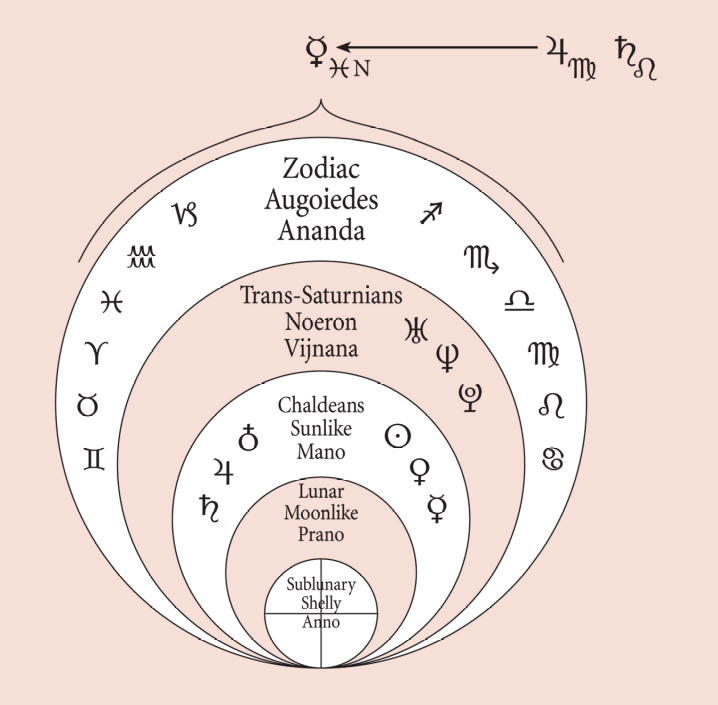
The five sheaths in Vedanta and the five vehicles in Neoplatonism in a cosmological context. (Reproduced courtesy of Wisdom’s Goldenrod. From Anthony Damiani, Astronoesis: Philosophy’s Empirical Context, Astrology’s Transcendental Ground, fig. 167, p. 347.)
Although Damiani discusses the koshas and soul vehicles in many contexts, his most sophisticated accounts are probably to be found in the two class series on soul in Plotinus “Plotinus: Soul, Series 1” and “Plotinus: Soul, Series 2.”
Another way to find class transcripts on the koshas is to search the document archive using “kosha” as a keyword.
There are also some diagrams in the sketchbooks that show the different levels of the koshas. To find them, search the diagram archive using “koshas” as a keyword.
The Four and Sixteen States of Consciousness
Another Vedantic idea that Damiani found to be quite fertile was that of the four states of consciousness: (1) turiya (the transcendent fourth state), (2) prajna (deep sleep), (3) taijasa (dream), and (4) vaishvanara (waking). These are set forth in the Mandukya Upanishad, where they are described as the “four quarters of Atman.” Damiani thought this fourfold division of consciousness described something very profound about the structure of reality.
He correlated the four states with both the four quadrants and the four rings of the metaphysical chart. In other words, they form a hierarchy of One, Being, Soul, and Body (when correlated with the four quadrants), or a hierarchy of Being-Life, Intellect, Soul-Nature, and Body (when correlated with the four rings of essential dignities).
When the two views are combined, we get sixteen states of consciousness, since each of the four quadrants is itself divided into four by the four rings. For example, if turiya is correlated with the first quadrant and the rulership ring, prajna with the exaltation ring, taijasa with the detriment ring, and vaishvanara with the fall ring, then the dignities in the rulership ring of the first quadrant will be correlated with turiya-turiya, the dignities in the exaltation ring with turiya-prajna, the detriments with turiya-taijasa, and the falls with turiya-vaishvanara.
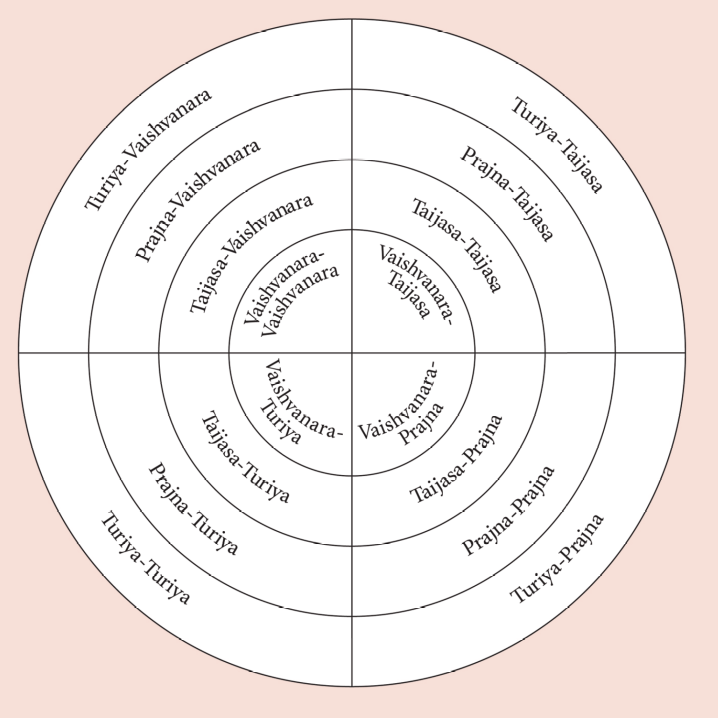
The sixteen states of consciousness. (Reproduced courtesy of Wisdom’s Goldenrod. From Anthony Damiani, Astronoesis: Philosophy’s Empirical Context, Astrology’s Transcendental Ground, fig. 30, p. 70.)
There are also many diagrams in the sketchbooks that depict these correlations; to find them search using the keyword “Mandukya.”