Paul Brunton as Spiritual Guide
In the 1940s, Anthony Damiani was working in Weiser’s, a popular New York City bookstore that featured books on spirituality and the occult. It was there that he discovered books by Paul Brunton, a prolific English writer who traveled in India in the 1930s to discover people who possessed genuine spiritual gifts. His first book, A Search in Secret India, quickly became a worldwide success and an awakener of readers to the profundity of Indian spirituality.
“A Search, first published in London in 1934, skyrocketed to popularity and has since sold over 500,000 copies worldwide. Along with Autobiography of a Yogi and Christopher Isherwood’s Ramakrishna and His Disciples, it continues to be one of the most inviting, exciting gateways to the mystical Hindu environment.” –Hinduism Today, Dec., 1991
PB, as he liked to be called, rapidly became the go-to authority on Eastern Spirituality in the course of authoring another ten well-received books by 1942. He re-visioned, in English for the modern era, the Perennial Spiritual Philosophy. Especially significant for aspiring mystics and philosophers were his books The Quest of the Overself, The Hidden Teaching Beyond Yoga, and The Wisdom of the Overself. These titles were likely the ones that propelled Damiani to ask Dutton, the publisher, to forward a letter to PB requesting an interview. As it turned out, PB was staying in NYC at the time; they met, and Damiani offered to be of assistance to PB. (For in-depth information about PB’s life and writings, see the website of the Paul Brunton Philosophic Foundation, www.paulbrunton.org.)
Fast-forward to 1967, when Damiani’s son Steve Damiani opened the American-Brahman Bookstore in Ithaca, NY. The following year, Anthony Damiani began giving classes to a quickly growing number of students. They focused on the writings of Paul Brunton, Carl Jung, Plotinus, as well as Vedanta, Buddhism, and Astrology. Damiani was broad in his approach, following up ideas or themes in the literature of various philosophic traditions to deepen his understanding of those themes. And Paul Brunton was a continual and major source for Damiani’s explorations and class discussions.
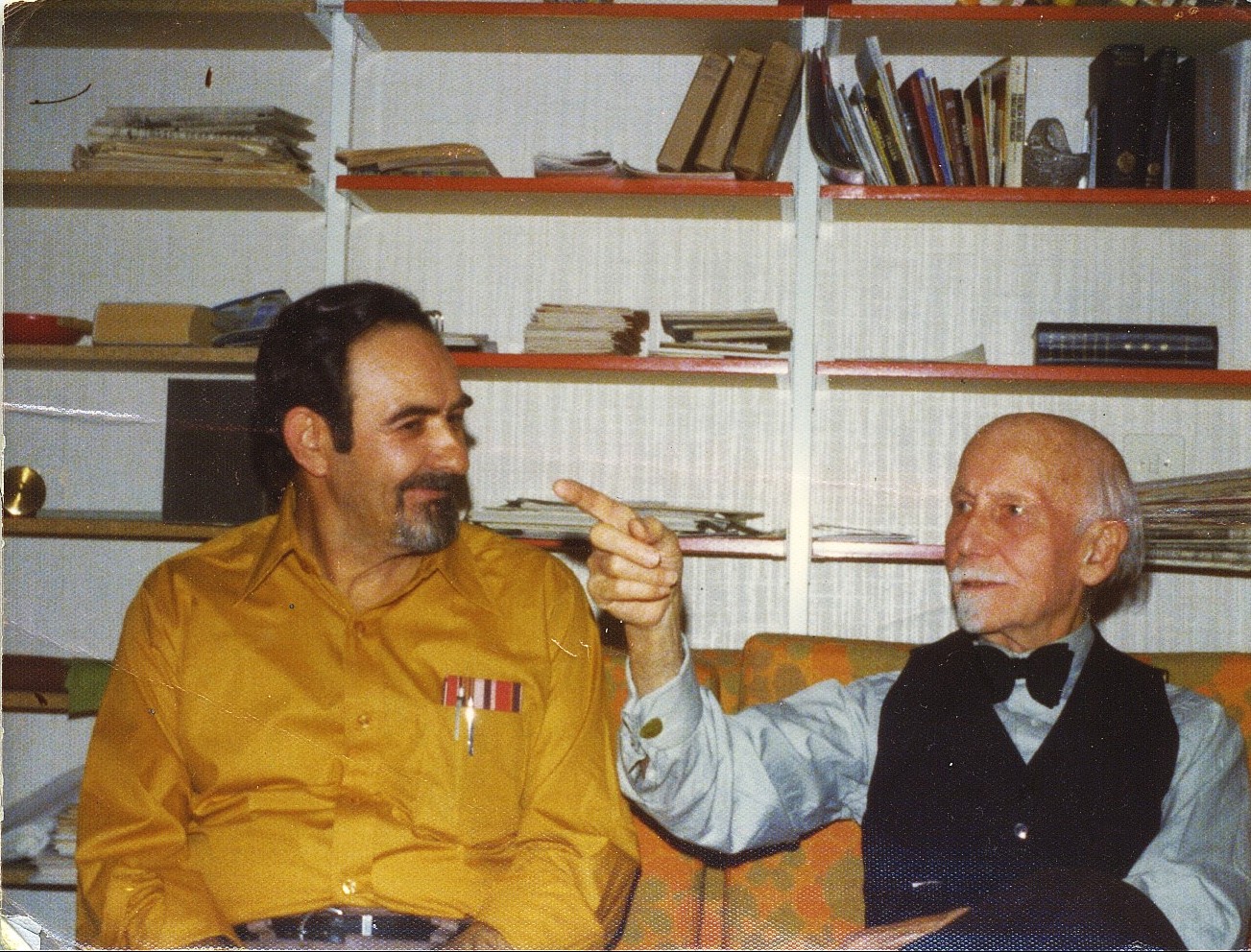
After PB stopped authoring books (the last appeared in 1952), he continued to write for the next thirty years and created a large body of work that became twenty-eight topical categories on every aspect of spiritual development (a major selection is contained in the posthumous The Notebooks of Paul Brunton). And a complete digital archive of his work can be found at the Archives of Paul Brunton, https://www.pbarchives.org/. It is a testament to Damiani and his students who worked tirelessly for many years to comprehend the major topics of the Perennial Philosophy that at the end of PB’s life, he trained Damiani’s students to act as editors for his large written legacy to be processed for publication and preservation. This was a multi-stepped and multi-year endeavor by many of Damiani’s students.
Damiani spent hours poring over the unpublished writings and devoted many classes (in 1982-84—the final years of his life) to the topics already mentioned and also to PB’s teachings on Mind-in-Itself, World-Mind, World-Idea, Overself, the sage, the intellect, meditation, emotions and ethics. The transcripts of these classes are preserved in this archive.