Damiani often used Ptolemaic cosmology as a framework to represent a hierarchy of being and knowing, where the fixed stars, or inerratic sphere, represent the level of Intellect (the Divine Mind or Intellectual-Principle), the seven planetary spheres (which include the Sun and Moon) surrounding our Earth represent the Soul and its powers, and the Earth itself represents the body or the sensible cosmos. These three components of the cosmos thus represent a hierarchy of supersensible principles that themselves can be understood at many levels.
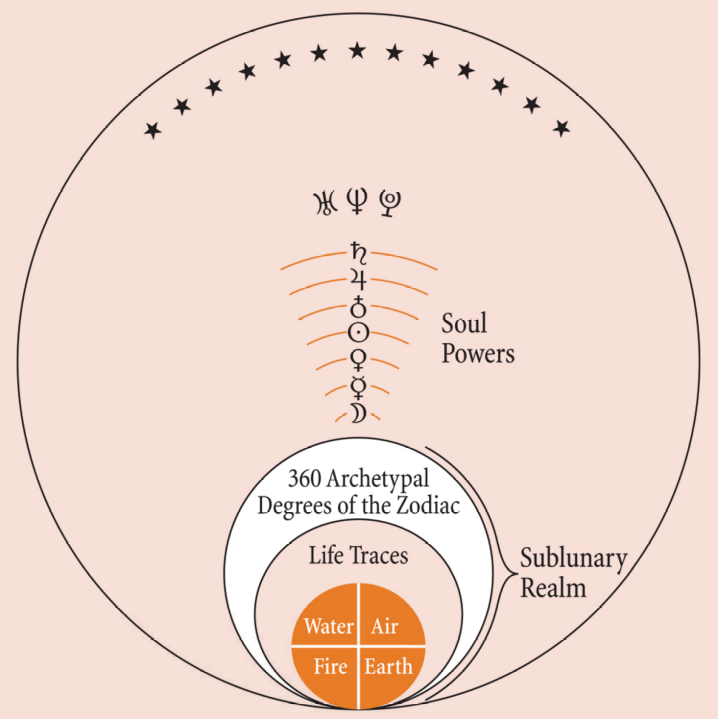
The fixed stars, planetary spheres, and the sublunary realm. (Reproduced courtesy of Wisdom’s Goldenrod. From Anthony Damiani, Astronoesis: Philosophy’s Empirical Context, Astrology’s Transcendental Ground, fig. 107, p. 249.)
The Metaphysical Chart (Astrological Mandala)
But his master symbol is what he sometimes called “the astrological mandala” or “the metaphysical chart.” Here we will briefly describe analytically the components of the astrological mandala. As to its meaning, well, explicating, unfolding, and amplifying all the meanings buried in this symbol occupied Damiani for the last fourteen years of his life and cannot be easily summarized here!
His book, Astronoesis, published posthumously, is an attempt to put down in writing some of his profoundest insights about the meaning of the astrological mandala. And the transcripts and papers in the archive are a treasure house filled with his dynamic explorations of different aspects of the astrological mandala, and they provide a kind of history of his efforts at unpacking this most potent of symbols.
Here’s one version of the metaphysical chart:
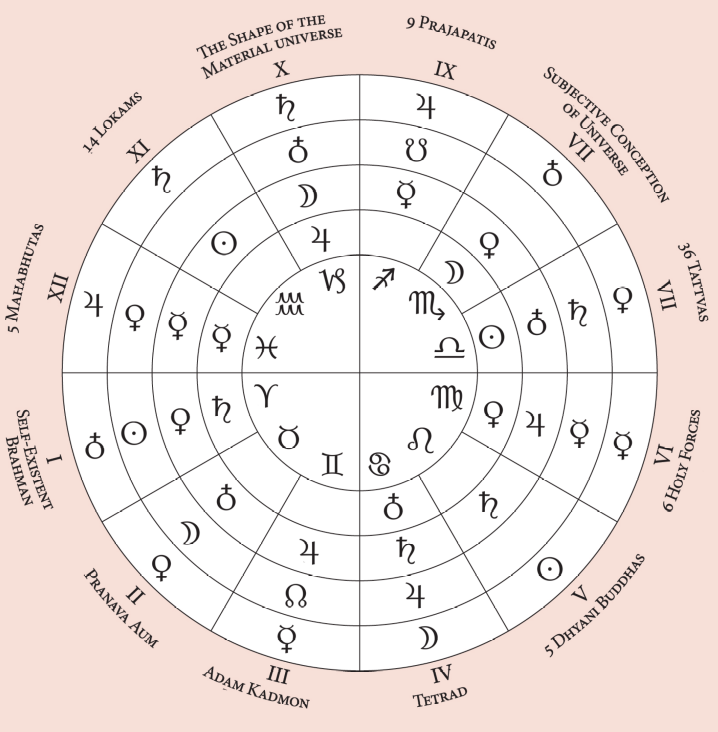
The metaphysical chart. (Reproduced courtesy of Wisdom’s Goldenrod. From Anthony Damiani, Astronoesis: Philosophy’s Empirical Context, Astrology’s Transcendental Ground, fig. 12, p. 53.)
To start with, it’s a circle divided into twelve equal sectors, called “houses.” Each sign of the zodiac is correlated with one of the twelve houses—for example, Aries to house 1, Taurus to house 2, and so forth. On the outside of each house is a phrase derived from T. Subba Row’s explanation of the metaphysical meanings of the twelve zodiacal signs from Aries to Pisces (see his essay “The Twelve Signs of the Zodiac”). Row saw the twelve signs as representing a progression from the Absolute to the sensible world. Damiani was inspired by this article on the zodiac and felt that Row had established the foundations of astrology on its proper ontological, or better yet, meta-ontological level.
Here is a key to the glyphs of the planets and zodiacal signs used in the metaphysical chart and some of the other diagrams in the archive:
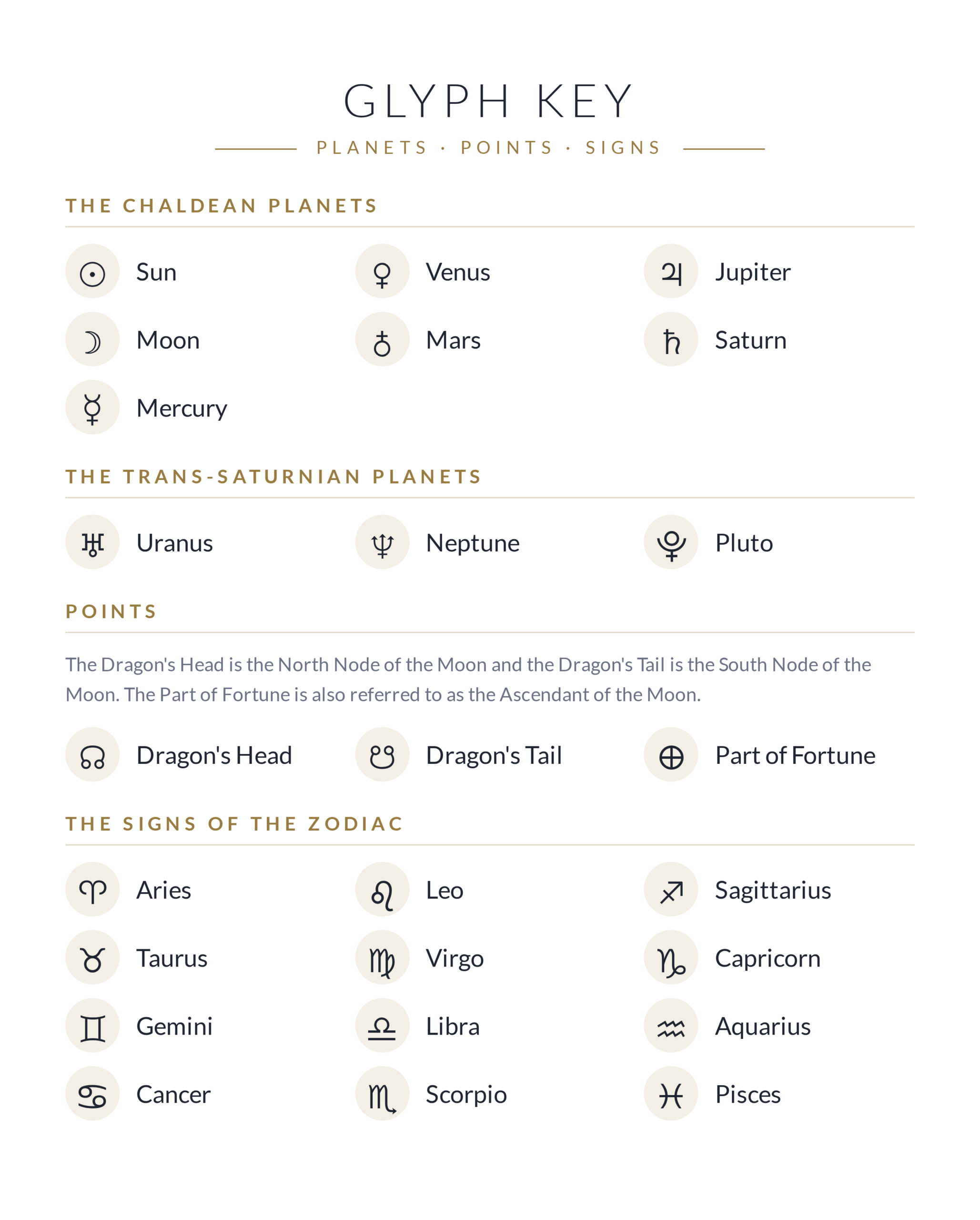
In each house, there are glyphs of some of the “Chaldean planets”—that is, Saturn, Jupiter, Mars, Venus, Mercury, Sun, and Moon—as well as the Dragon’s Head and Tail (also called the Moon’s North and South Nodes). These glyphs are arranged in four concentric rings.
The Four Essential Dignities
To explain the significance of these rings, we need to discuss briefly the notion of the essential dignities in traditional Western astrology. According to a tradition dating back to antiquity, each of the Chaldean planets is said to have a particular affinity with certain signs. In these signs, the planet is said to be in either rulership or exaltation. In the opposite signs, the planet is said to have a disaffinity and is said to be in either detriment or fall. For example, Mars is in rulership in Aries and is in detriment in the opposite sign, Libra; Jupiter is in exaltation in Cancer and in fall in the opposite sign, Capricorn. These four placements of planets in signs are called the “four essential dignities.”
The Four Rings of the Metaphysical Chart
The astrological mandala provides a perspicuous way of seeing, for each sign (or house), which planets have an essential dignity in that sign (or house).
In the outermost ring, in each house, draw the glyph for the planet in rulership in that sign. The resulting ring of planets in rulership in various signs is called the “rulership ring.”
In the next ring, going toward the center of the circle, draw in each house the glyph for the planet in exaltation in that sign (if there is none, indicate that it is “empty” by drawing three ellipsis dots). The resulting ring is called the “exaltation ring.”
In the next ring, draw in each house the glyph for the planet in detriment in that sign. The resulting circle is called the “detriment ring.”
In the last ring, draw in each house the glyph for the planet in fall in that sign (if there is none, indicate that it is “empty” by drawing three ellipsis dots). The resulting circle is called the “fall ring.”
For each house, there is at most one planet in each ring, and sometimes, there is a house with no planets in a given ring. (Every house has a planet in rulership and a planet in detriment, but only some houses have a planet in exaltation or planet in fall.)
The Dignities as the Gods Constituting the Monads of Neoplatonism
Damiani didn’t devise this schema of essential dignities; it is part of traditional astrology. However, he was not satisfied with the meanings given to them in ancient and contemporary astrology. In particular, he thought that the negative connotations given to planets in detriment and fall were misinterpretations and value judgments at a psychological level of grander ontological truths. The planets in any of the four essential dignities were, on their own level, gods, members of the Divine Intellect (in Plotinian terms), possessing deep wisdom and acting as sources of beneficent activity.
To establish the deepest level of the meaning of the essential dignities, Damiani integrated the Neoplatonic theory of monads, unific principles of being, knowing, and activity with the schema of the essential dignities.
He correlated the monad of Being with a subset of the rulerships (that is, the rulerships of houses 1-4 and houses 9-10) and the monad of Life with the rest of the rulerships (that is, the rulerships of houses 5-8 and houses 11-12).
He correlated the monad of Intellect with the exaltations.
He correlated the monad of Soul with a subset of the detriments (that is, the detriments of houses 3-4 and houses 7-11) and the monad of Nature with the rest of them (that is, the detriments of houses 1-2, houses 5-6, and house 12).
He correlated the monad of Body with the falls.
Thus the rulership ring comprises the Being and Life monads, the exaltation ring is the Intellect monad, the detriment comprises the Soul and Nature monads, and the fall ring is the Body monad.
Alternatively, the four nested rings within the metaphysical chart represent, going from the outermost to the innermost, Being and Life, Intellect, Soul and Nature, and Body, respectively. In some versions of the astrological mandala, the rings are color coded, using six colors, to indicate which glyphs are for planets in the Being, Life, Intellect, Soul, Nature, and Body monads:
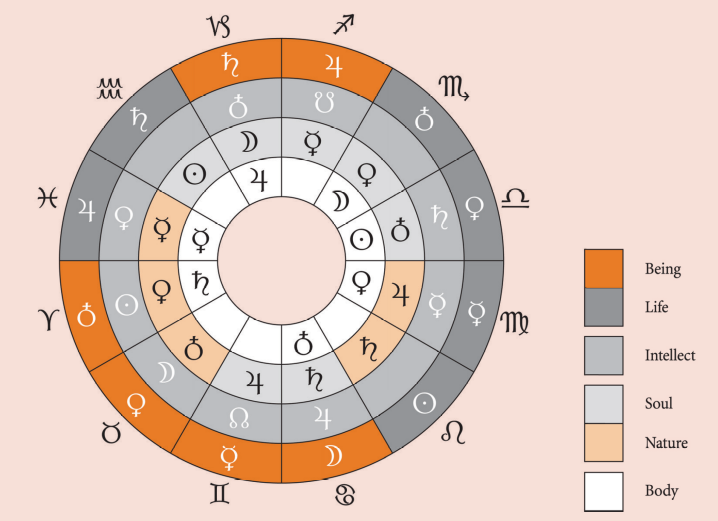
The metaphysical chart with color-coded rings. (Reproduced courtesy of Wisdom’s Goldenrod. From Anthony Damiani, Astronoesis: Philosophy’s Empirical Context, Astrology’s Transcendental Ground, fig. 44, p. 110.)
The Four Quadrants of the Astrological Mandala
Although the circle of the metaphysical chart has twelve sectors (houses), it can also be viewed as being divided into four quadrants by a cross formed by two diameters, one that divides the circle into bottom and top semicircles and one that divides the circle into left and right semicircles.
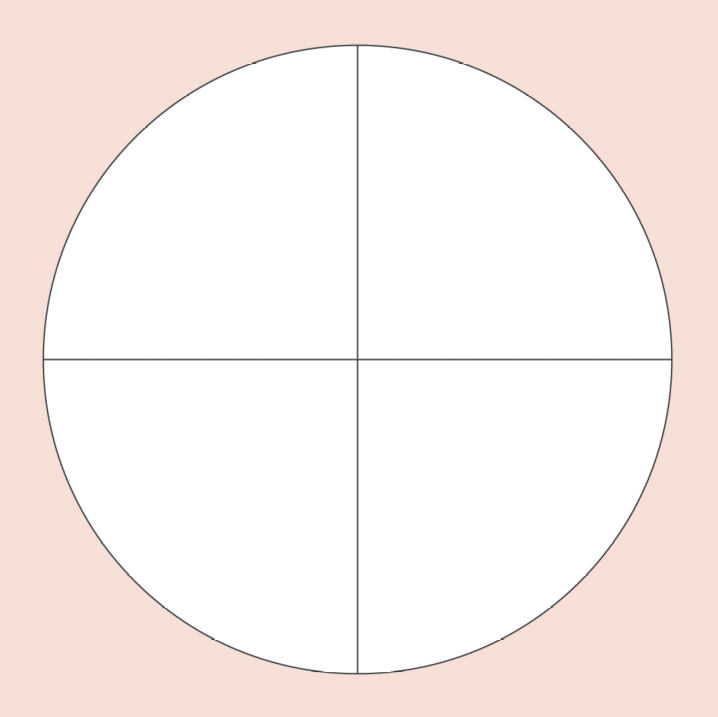
A circle divided into four quadrants by a cross. (Reproduced courtesy of Wisdom’s Goldenrod. From Anthony Damiani, Astronoesis: Philosophy’s Empirical Context, Astrology’s Transcendental Ground, fig. 6,
In a natal horoscope, these diameters form the cardinal cross. The ascendant is the degree of the zodiac that was rising on the eastern horizon at birth (the cusp of house 1), and the descendant (the cusp of house 7) is the opposite degree that was setting at birth. The midheaven is the degree directly overhead at birth (the cusp of house 10) and the descendant is the degree opposite it (the cusp of house 4).
Each quadrant comprises three houses and they are numbered from 1 to 4 moving counterclockwise, starting from house 1. Houses 1-3 comprise the first quadrant, houses 4-6 the second, houses 7-9 the third, and houses 10-12 the fourth.
Damiani thought the Number Four was one of the Divine Numbers and represented the fourfold nature of any unity. As such it structured things at many different levels, from the One itself to a natal chart. One of its primary meanings he derived from Plotinus’s three fundamental principles—The One, Intellectual-Principle, Soul—and their manifestation as the system of nature. This fourfold is symbolized by the four quadrants of the metaphysical chart:
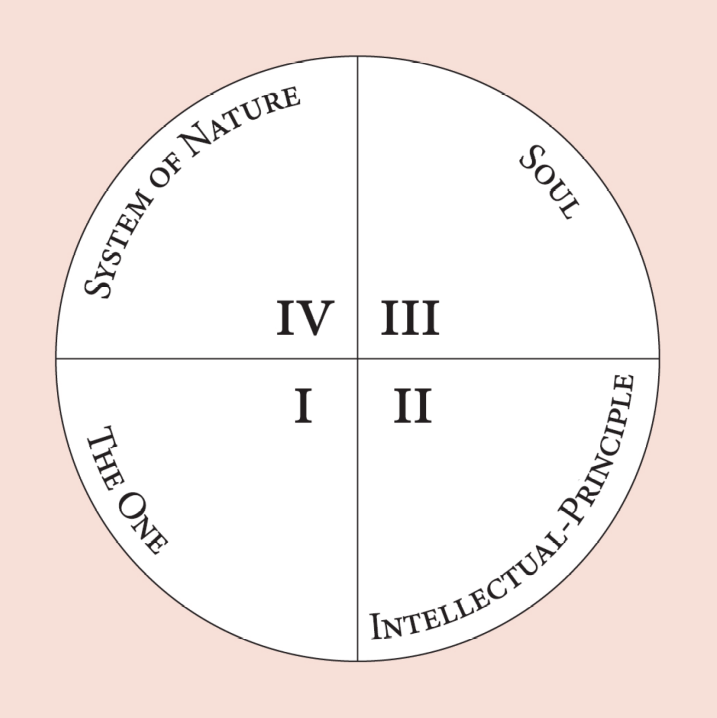
The four quadrants of the metaphysical chart. (Reproduced courtesy of Wisdom’s Goldenrod. From Anthony Damiani, Astronoesis: Philosophy’s Empirical Context, Astrology’s Transcendental Ground, fig. 7, p. 48.)
Damiani explains the meaning of the four quadrants more fully in chapter 1 of Astronoesis, in the section “The One: Symbolization.”
Planets as the Superessential Unities in Neoplatonism
If instead of looking at which planets in signs constitute the monads of Being, Life, Intellect, Soul, Nature, and Body, we consider all the signs in which a given planet is in dignity—that is, all the signs in which it is in either rulership, exaltation, detriment, or fall, we arrive at a way of symbolizing the unity of that planet. For example, the unity of Jupiter would be symbolized by a list or an arrangement of all the signs in which Jupiter is in dignity.
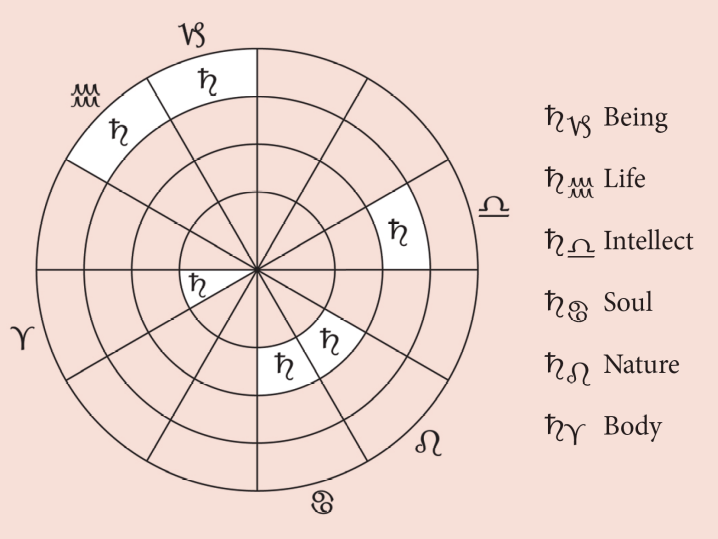
The henad of Saturn. (Reproduced courtesy of Wisdom’s Goldenrod. From Anthony Damiani, Astronoesis: Philosophy’s Empirical Context, Astrology’s Transcendental Ground, fig. 163, p. 342.)
Damiani often referred to these planetary unities, or gods, as “henads.” This term is borrowed from Neoplatonic philosophy, particularly that of Proclus, and it literally means “ones.” (For background on monads and henads, consult Proclus, On the Theology of Plato and his commentaries on Plato’s dialogues, especially Timaeus and Parmenides.) Many of Damiani’s diagrams feature both monads and henads, as he explored both how they are related to the One and the other Plotinian hypostases and how they are fundamental principles at the heart of astrology.
Substance and Function Represented in the Astrological Mandala
Damiani often characterized the signs of the astrological mandala as substance and the planets in dignity in those signs as function. Substance here refers not to some stuff that makes something up, but to authentic Being, what always is and never becomes other than itself. That is, substance is regarded as Idea, as Plato and Neoplatonism conceived the divine Ideas. Function refers to the essential activity of a substance, the act that is inseparable from the substance. Thus a planet in a sign is a symbol of the duality-in-unity of substance and function. This symbolism can be a very powerful tool in synthesizing, or harmonizing, philosophic traditions that privilege either substance or function (e.g. most Hindu traditions seem to honor substance and denigrate function, whereas most Buddhist traditions honor function and denigrate substance). In chapter 1 of Astronoesis, Damiani shows how the symbolism of substance and function can even be used to hint at the ultimate coincidence of substance and function in the One itself.
The following diagram shows how substance and function are combined in the astrological mandala:
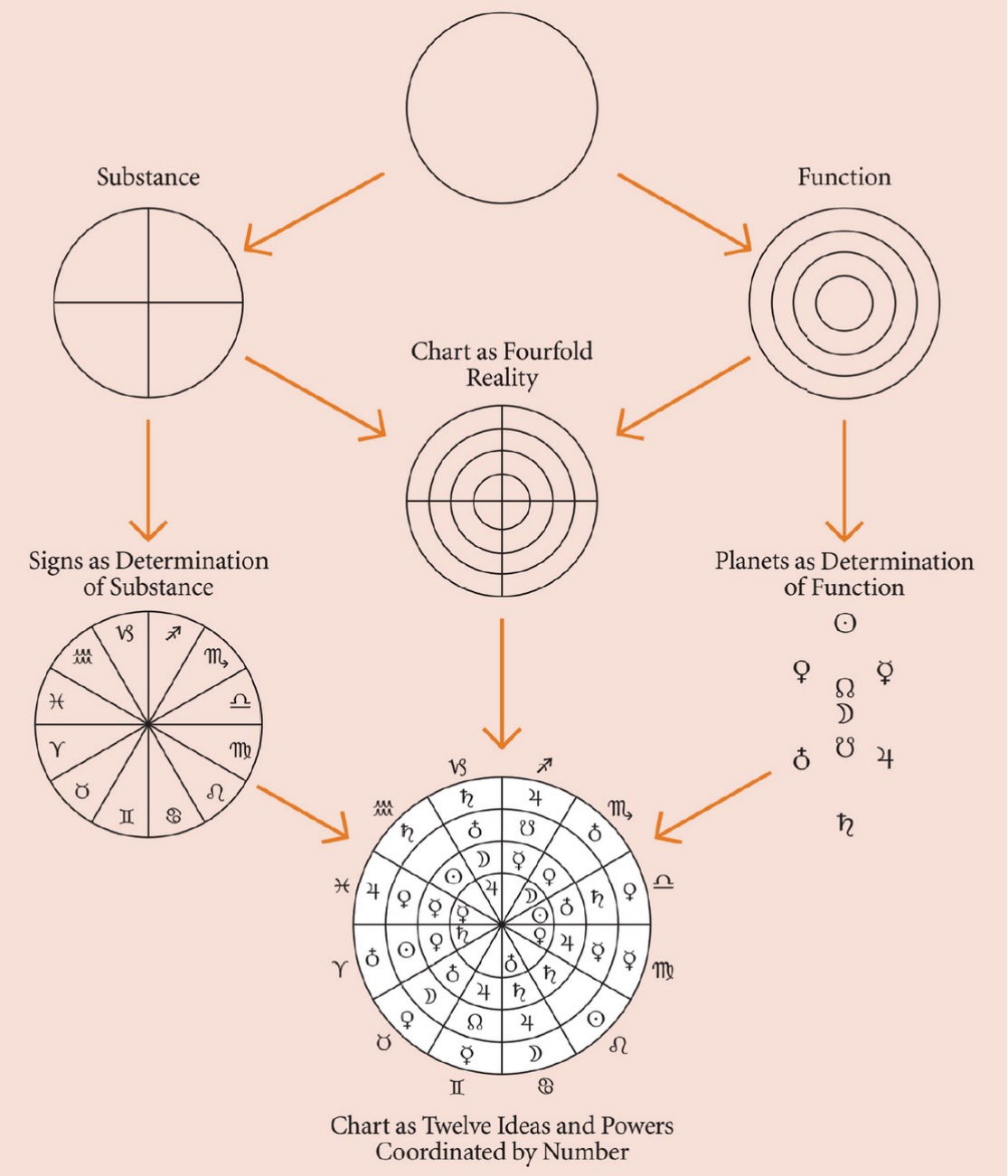
Substance and Function Represented by the Signs and Planets of the Astrological Mandala. (Reproduced courtesy of Wisdom’s Goldenrod. From Anthony Damiani, Astronoesis: Philosophy’s Empirical Context, Astrology’s Transcendental Ground, fig. 135, p. 317.)
Diagrams Derived from the Metaphysical Chart
A majority of the mandala diagrams in the diagram archive are based on the metaphysical chart. Sometimes Damiani focuses on one part of the metaphysical chart, for example, one of the four quadrants, and assigns various meanings to the houses or dignities in that quadrant. Or he might divide the chart into three sections of four signs each and focus on just one of these thirds. Or he might take the dignities from one third of the chart and spread them around the twelvefold chart, in effect making a new twelvefold chart from one third of the larger chart. Or he might take the dignities of the four rings and arrange them as horizontal lines, sometimes indicating with arrows how the dignities in one line relate to those above and below it.
These diagrams often have many sets of labels for the sectors of the circle depicted and the dignities in the houses, labels drawn from many different philosophic and spiritual traditions, and the leading exponents of them, including Plato, Aristotle, Plotinus, Proclus, Advaita Vedanta, Samkhya, Kashmir Shaivism, Buddhism, Scholasticism, Alchemy, Kant, Theosophy, and Paul Brunton (PB). These diagrams thus exhibit the breadth of Damiani’s vision, his welcoming of many different points of view, his drive to unite what seems disparate, and his conviction that partisan bias had no place in the quest for Truth.